
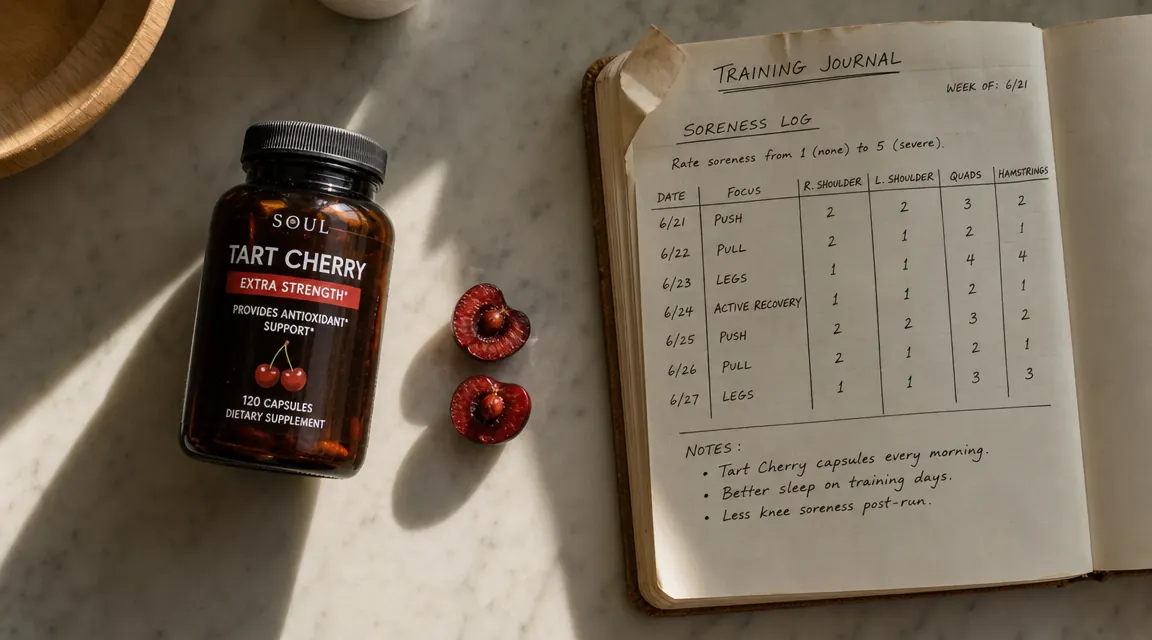
Eight weeks ago I was waking up at 5:50 every morning and taking a mental inventory of my body before I even put my feet on the floor. Hamstrings tight. Lower back grumpy. Shoulders stiff from Monday's overhead work. That inventory was taking longer than it should for a 41-year-old who lifts four days a week, sleeps seven hours, and eats reasonably well. I was not injured. I was just consistently, low-grade sore, and it was bleeding into my first two sets of every session.
A coworker who drives a semi five days a week had been on Carlyle tart cherry extract for about three months. He said his legs felt less 'concrete' after long days behind the wheel. I was skeptical but the bottle costs less than a large Chipotle order, so I bought two and kept a daily soreness log for the full eight weeks, four as a baseline, four with tart cherry. What I found surprised me more in the sleep department than the soreness department, and I want to be straight with you about both.
The Quick Verdict
Carlyle tart cherry extract is a low-cost, consistent performer for reducing next-day soreness and improving sleep onset. Best results showed up around week six. Not a replacement for protein, sleep, or deload weeks, but a solid daily add-on for working adults who train hard.
Amazon Check Today's Price →Still waking up stiff after 7 hours of sleep? That soreness has a cheap fix.
Carlyle tart cherry extract is 200 capsules at one of the lowest per-serving prices in the category. Runs about a 3-month supply at two caps a night. Worth checking current pricing before the next price fluctuation.
Amazon Check Today's Price on Amazon →How I Tracked This
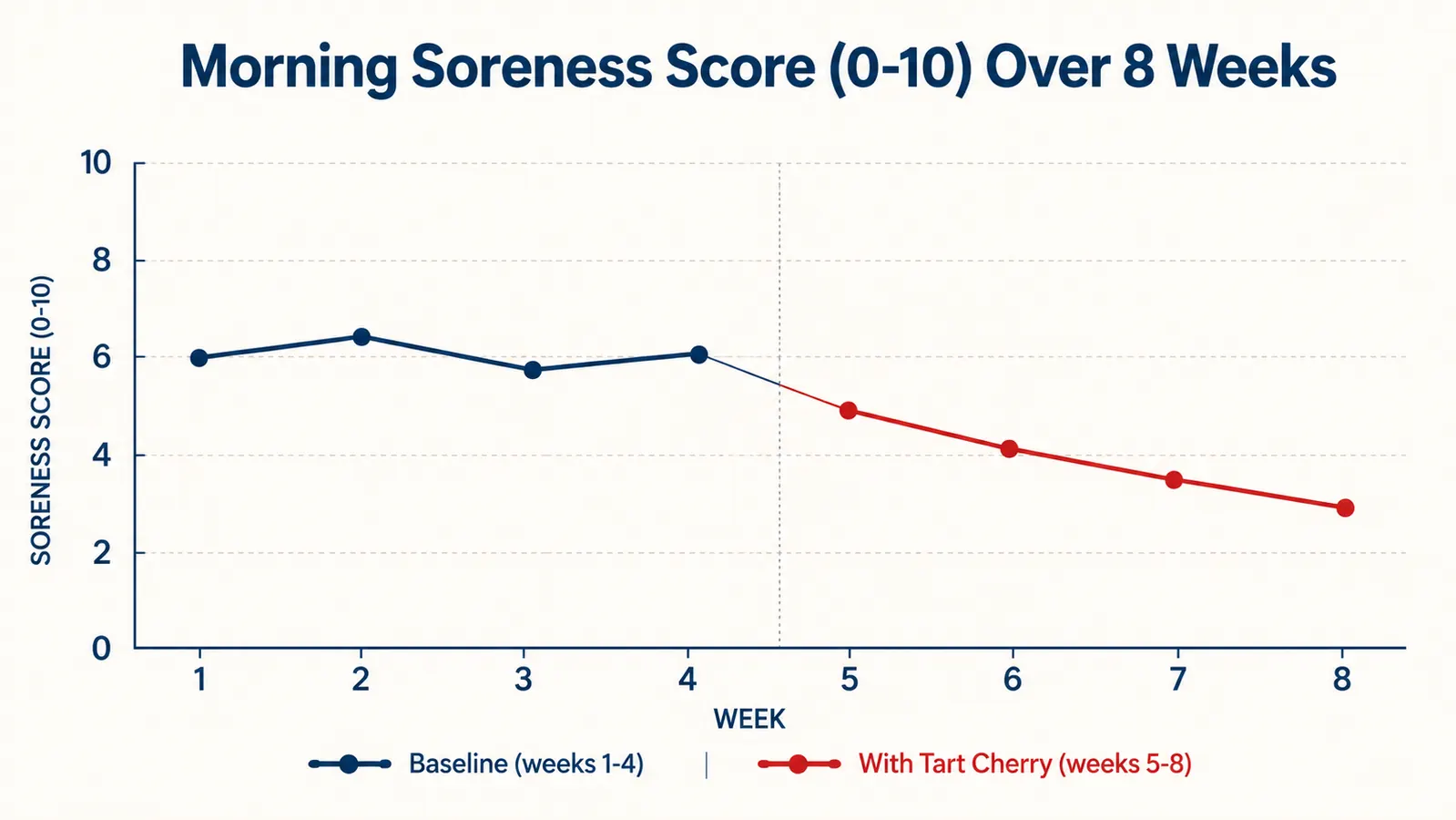
Weeks one through four I took nothing new. Same training schedule: upper/lower split, four days, roughly 55-65 minutes per session. I rated my morning soreness on a 1-10 scale at 6 a.m. every day, before coffee, before moving. I also tracked time to fall asleep (estimated, no wearable) and whether I woke up between 2 and 4 a.m., which had been a recurring thing for me. Baseline four-week average: 5.6 soreness, roughly 22 minutes to fall asleep, woke up mid-night about four times per week.
Weeks five through eight I added two Carlyle capsules at 9 p.m., about 90 minutes before bed. No other changes. Same training, same food, same sleep window. My four-week averages with tart cherry: 3.8 soreness, roughly 14 minutes to fall asleep, woke up mid-night about 1.5 times per week. The sleep shift showed up first, around day 10. The soreness shift was more gradual, meaningful by week seven. I want to be careful here: this is an n=1 log, not a clinical study. But the direction was consistent and the magnitude surprised me.
I also had my wife do the same tracking for her first three weeks. She is a 44-year-old who runs 25 miles a week and works as a school counselor. She reported similar sleep improvement but said her legs felt 'less heavy' starting around day 12. Different training stimulus, similar trajectory.
What Is Actually in This Bottle
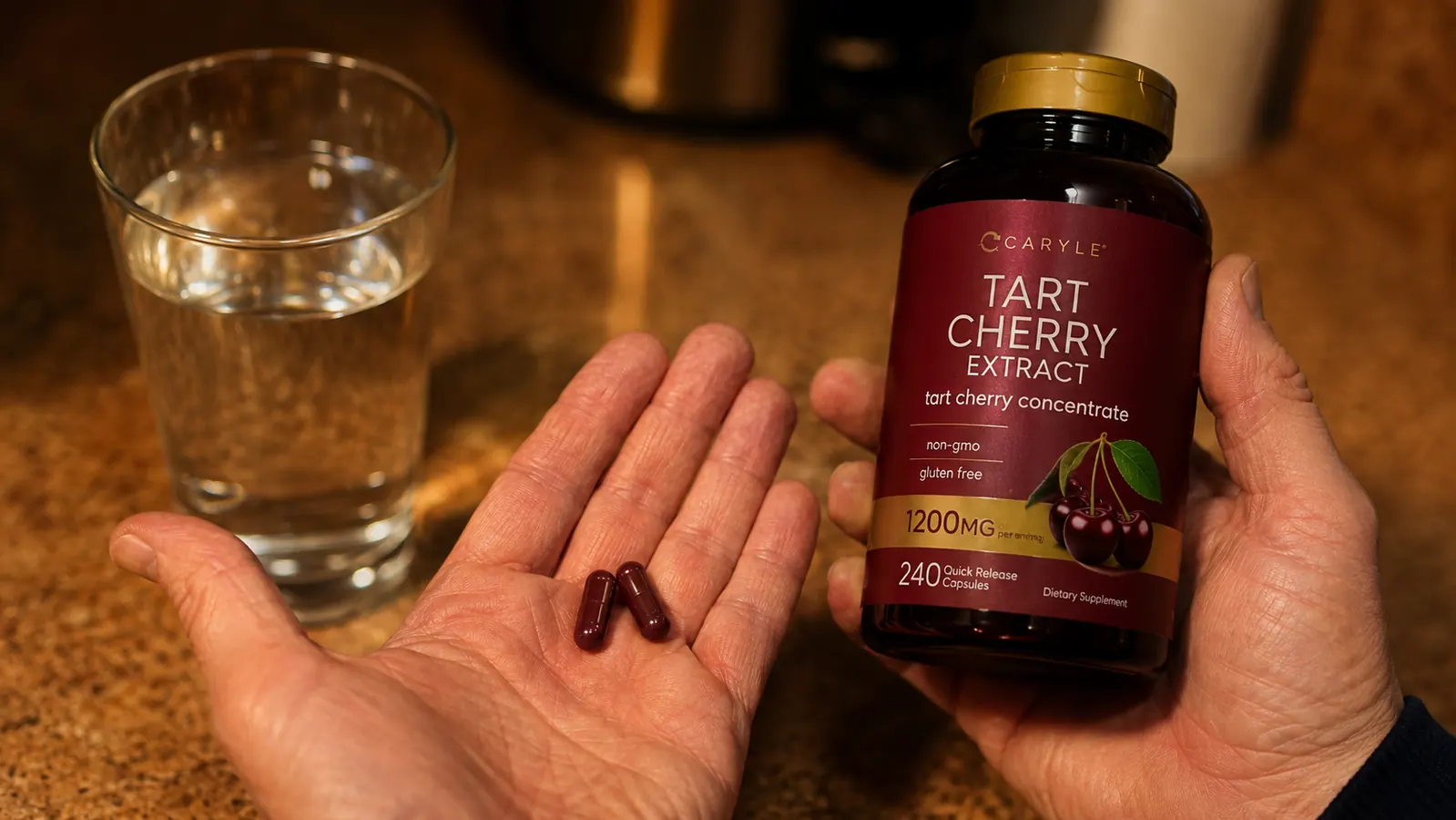
Carlyle tart cherry extract uses Montmorency tart cherry, which is the specific cultivar that most of the recovery research points to. Each two-capsule serving delivers 1,000 mg of extract. Montmorency cherries are naturally high in anthocyanins, the polyphenol compounds that inhibit inflammatory enzymes in a pathway that is similar to how ibuprofen works, just slower and without the gut irritation. The melatonin content is why you hear about tart cherry for sleep. Montmorency cherries contain natural melatonin at measurable levels, which stacks on top of the anti-inflammatory effect.
What Carlyle does well here is staying clean. The capsules are non-GMO, gluten-free, and the formula is not padded with fillers or proprietary blends. No magnesium, no B vitamins, no ashwagandha. Just the extract. That makes it easy to add to an existing stack without worrying about double-dosing something. If you already take magnesium glycinate at night, which I do, tart cherry layers on cleanly.
The 200-count bottle at the current price works out to 100 two-capsule servings, roughly three months at daily use. That per-serving cost is well below most branded competitors that use similar source material. The main place budget brands cut corners is sourcing, and I have no lab verification here. What I can say is that my subjective results tracked with what the research predicts, which is at least consistent with real extract potency.
What Changed Week by Week
Week five felt identical to my baseline. If you add tart cherry and expect to feel something in three days, you will probably quit. The half-life of these compounds is short, so you need to build consistent tissue saturation. Most human studies use protocols of four to ten days before testing for effect. Week six was where I noticed the sleep onset shift. I was not lying awake running through my to-do list for as long. This is a subtle thing, but if you have ever dealt with that 11 p.m. wired feeling after an evening lift, you will notice when it softens.
By week seven my morning soreness scores were reliably sitting between 3 and 4. Prior to tart cherry, anything below a 4 only happened on complete rest days. Now I was seeing 3.5 the morning after a deadlift session. That is the change I was actually looking for. Two capsules at night, morning soreness down meaningfully, without changing anything else.
The sleep shift showed up around day 10. The soreness shift came later, week seven. If you quit before week four, you quit too early.
Week eight I ran an experiment and skipped four consecutive nights to see if I could detect a return. By day three off, my morning soreness was back in the 5-6 range. By day four, I was waking up at 2 a.m. again. That rebound told me more than the initial buildup did. Something was actually working.
Where It Comes Up Short
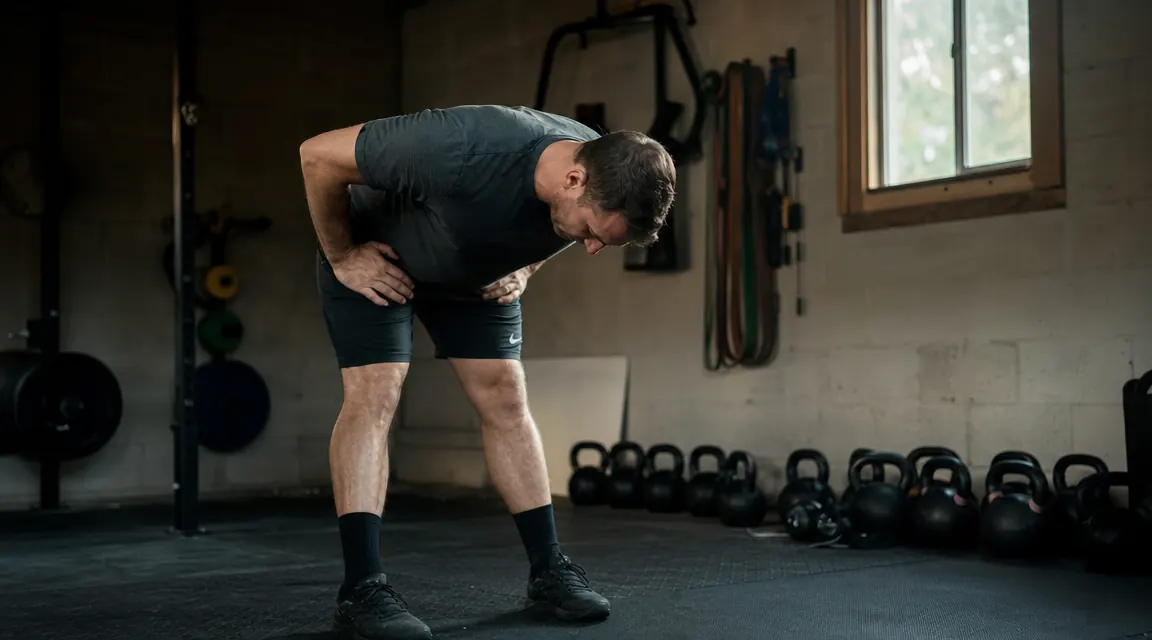
Tart cherry does not do much for acute, session-day soreness. If you have a brutal leg day and your quads are screaming by 8 p.m., two capsules are not going to touch that. It works on the cumulative inflammatory burden, not the acute spike. That distinction matters. People who try tart cherry expecting it to function like ibuprofen will be disappointed. It is a recovery accelerator, not a painkiller.
There is also a staining risk that nobody on the label warns you about. The capsules occasionally leave a faint red residue on your lips or in the sink if you brush your teeth right after taking them. Minor thing, but worth knowing. More meaningfully, if you are on any blood thinners or salicylate-sensitive, check with your doctor first. The anti-inflammatory mechanism is real enough that it is not totally benign in combination with other anti-inflammatory drugs.
And the 200-count bottle does not close with a particularly secure seal. After my first bottle, I decanted the rest into a smaller airtight jar. Not a dealbreaker, just note it.
Carlyle vs the Alternatives I Considered
Before committing to Carlyle, I looked at four other options. Tart cherry juice concentrate (Lakewood, Cheribundi) runs two to three times the cost per serving once you account for the refrigeration, the daily 2-ounce pour, and the added sugar you are drinking with it. The concentrate can work, but the capsule form is more practical for anyone who does not want to be measuring juice at 9 p.m. For a deeper breakdown on that question, the capsules versus juice comparison on this site is worth reading before you commit to either form.
Other capsule brands at the same dose point include Horbaach and NOW Foods. Both are legitimate. NOW's cherry extract is slightly better sealed but costs more per serving. Horbaach is comparable to Carlyle on price and I have heard the same general feedback on results. I went with Carlyle because the 200-count bottle offered the longest runway without reordering, which matters when you are testing a slow-build supplement.
The Science Behind Why This Actually Works
I want to give you enough context to evaluate this yourself without overselling it. The most cited research on tart cherry for exercise recovery comes from studies at Northumbria University and later replicated work published in journals including the Scandinavian Journal of Medicine and Science in Sports. The protocol that showed the clearest effect was loading for four to five days before a high-demand event, like a race or a maximal lifting test, and continuing for two to three days after. Chronic daily use at 1,000 mg appears to sustain lower baseline inflammation markers, which is the mechanism most relevant to people training consistently rather than peaking for events.
The melatonin pathway is separate and probably underappreciated. Montmorency cherries contain a measurable amount of phytomelatonin. At the dose you get from two capsules, you are not getting a knockout sedative dose, but you are nudging the system in the right direction. For someone whose sleep is already decent but whose sleep onset is slow, that nudge matters. For the ten reasons tart cherry capsules support muscle recovery specifically, there is a deeper breakdown on this site that goes through each mechanism.
Who This Is For
Carlyle tart cherry extract is the right pick if you are training three or more times a week, sleeping reasonably well but waking up stiffer than you should, and want a low-cost, low-risk add-on to your stack. It is especially well suited for people whose soreness is cumulative rather than acute, which describes most working adults who train consistently but do not have the luxury of two full rest days between sessions. Nurses, drivers, tradespeople who also lift, anyone whose body absorbs daily mechanical stress on top of intentional training. If you are already taking magnesium glycinate at night, tart cherry stacks cleanly with it.
Who Should Skip It
Skip it if you are expecting fast results. If your soreness problem is severe enough that you need relief in 48 hours, you need something more targeted, better sleep hygiene, a deload, more protein, or a conversation with a physical therapist. Tart cherry is a long game. Also skip it if you are taking prescription NSAIDs or blood thinners daily. And if your sleep is genuinely good, the sleep benefit will probably be invisible to you. You will get the inflammation support, but you will not feel the night-to-night shift that made this feel obvious to me.
What I Liked
- 200 capsules at one of the lowest per-serving costs in the category, roughly three months of daily use
- Non-GMO, gluten-free, no proprietary blends, stacks cleanly with existing magnesium or collagen routine
- Measurable soreness reduction from weeks six through eight of consistent daily use
- Sleep onset improvement noticeable by day 10 for most consistent users
- Montmorency cherry is the specific cultivar supported by most exercise-recovery research
Where It Falls Short
- Slow build, four to six weeks before the soreness effect is clear, quitters miss it
- Does not address acute soreness from a single hard session, think long-term not painkiller
- Bottle closure is loose, worth decanting after opening
- No third-party lab testing published, you are trusting the brand on extract potency
- Minor staining risk if taken immediately before brushing teeth
Two capsules at 9 p.m. is the smallest change I made with the clearest return.
If your mornings feel like a damage report, Carlyle tart cherry extract is worth a six-week test. At this price point, the risk is low enough that there is no reason to sit on the fence. Check what it is selling for today before the next price move.
Amazon Check Today's Price on Amazon →