
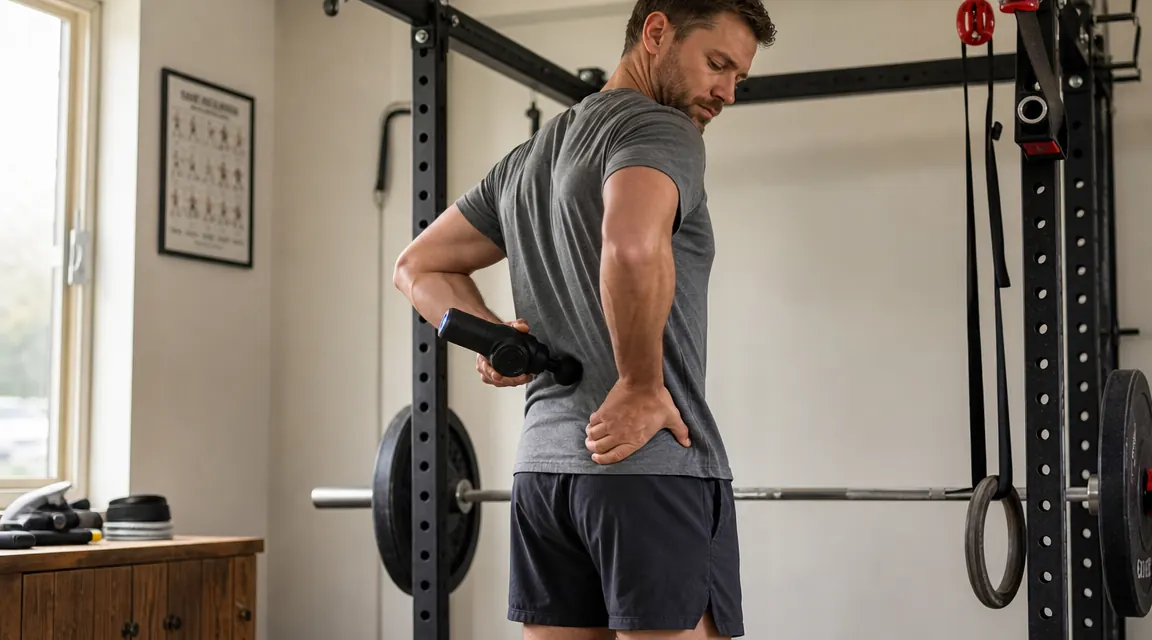
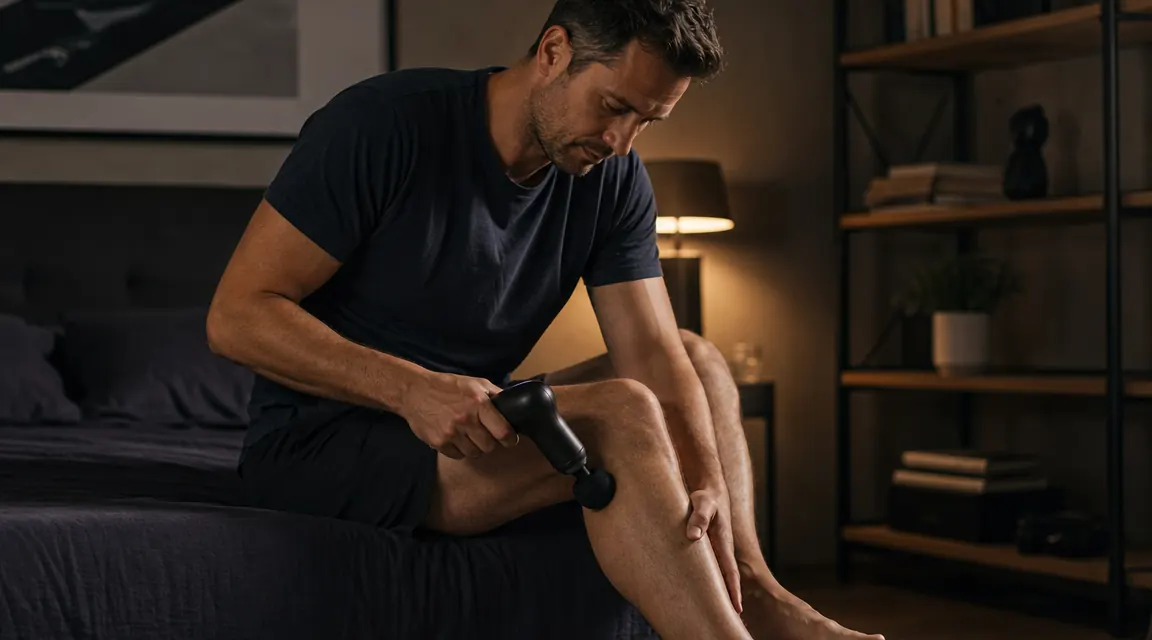
I deadlift four days a week and drive a desk chair the other eight hours. My lower back is basically a complaint department that never closes. I have tried foam rollers, lacrosse balls, a cheap handheld massager from a pharmacy, and a standing desk I stopped standing at after three weeks. None of it really touched the deep trap and erector tightness that builds up by Wednesday. So four months ago I ordered the RENPHO massage gun, set it on my nightstand, and made a rule: use it every single day before bed, no matter how tired I am. Here is what actually happened.
RENPHO is rated 4.6 stars across more than 30,000 reviews on Amazon, which is the kind of number that makes you wonder if anyone actually complained or if they are all from the same afternoon in 2022. I was skeptical. Four months later I am less skeptical, with a few caveats that matter depending on your specific situation.
The Quick Verdict
A genuinely solid daily-driver for lifters and desk workers with chronic back and trap tightness. Not the deepest gun on the market at this price, but quiet enough to use at 10pm without waking anyone up, and durable enough to survive four months of every-single-day use without a hiccup.
Amazon Check Today's Price →Your traps are holding tension you have been ignoring for three years. The RENPHO is the most practical way to fix that without booking a professional massage appointment.
4.6 stars, 30,000+ reviews. Click through to check the current price on Amazon and see which bundle includes the carry case.
Amazon Check Today's Price on Amazon →How I Have Used It for Four Months
My name is Dan. I am 38, 195 lbs, and I train out of a garage gym Monday through Friday, mostly barbell work: squats, deadlifts, overhead press, rows. I have a herniated L4-L5 that showed up on an MRI last year and makes my lower back unpredictably angry after heavy pulling. I also have the trapezius tightness that every person who does any barbell pressing and then sits hunched at a computer develops. I was not coming to the RENPHO from a starting point of mild soreness. I was coming from 'I need a heating pad just to fall asleep.'
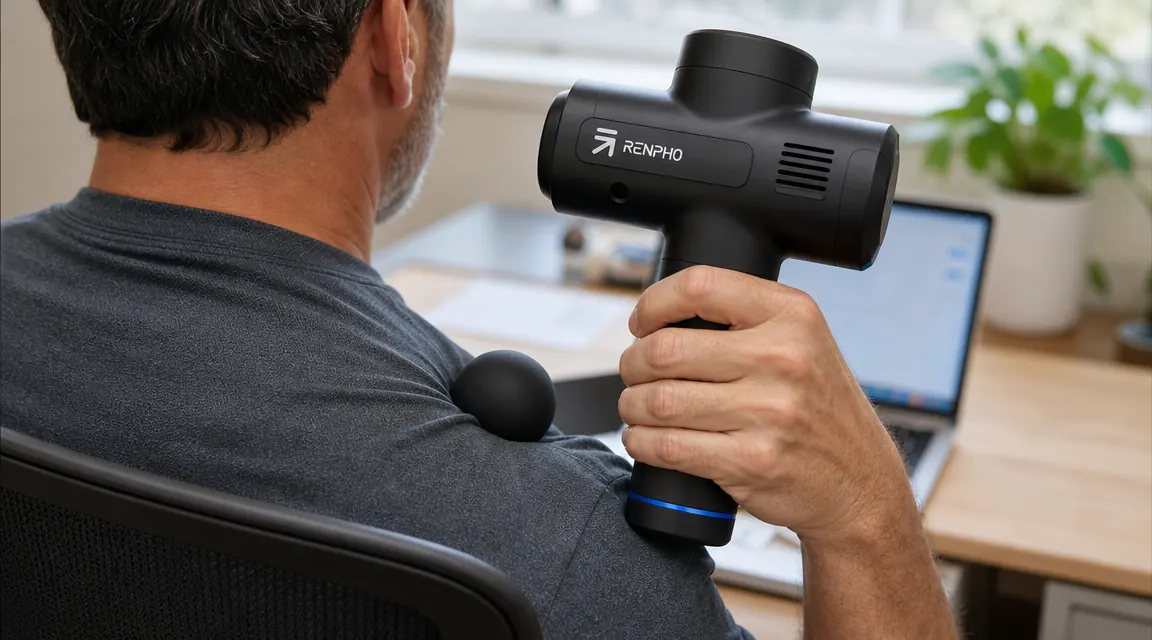
My protocol for the first eight weeks was simple: every night before bed, five minutes on the lower back erectors (speed 2, ball head), three minutes on each trap (speed 1 or 2, fork head), and two minutes on whichever glute or hamstring was grumbling that day. On particularly bad nights I would add another five minutes on the thoracic area before that. Total: roughly fifteen minutes per session. I tracked my perceived soreness every morning on a 1-10 scale for the first eight weeks.
Weeks nine through sixteen I got lazier with the timer and just used it until the target area felt noticeably looser, usually eight to twelve minutes total. The results held. I do not think the exact duration matters as much as consistency. The gun you will actually use every night beats the gun you will use perfectly twice a week.
What Changed in the First Four Weeks
Week one: nothing dramatic. I noticed my traps felt less like rope and more like muscle again by day four. Lower back was unchanged.
Week two: I started sleeping better. I think it was the trapezius work specifically. I have a habit of carrying my shoulders up around my ears when I am stressed, and apparently spending three minutes breaking that tissue down before bed actually lets my nervous system relax enough to sleep properly. This was not something I expected.
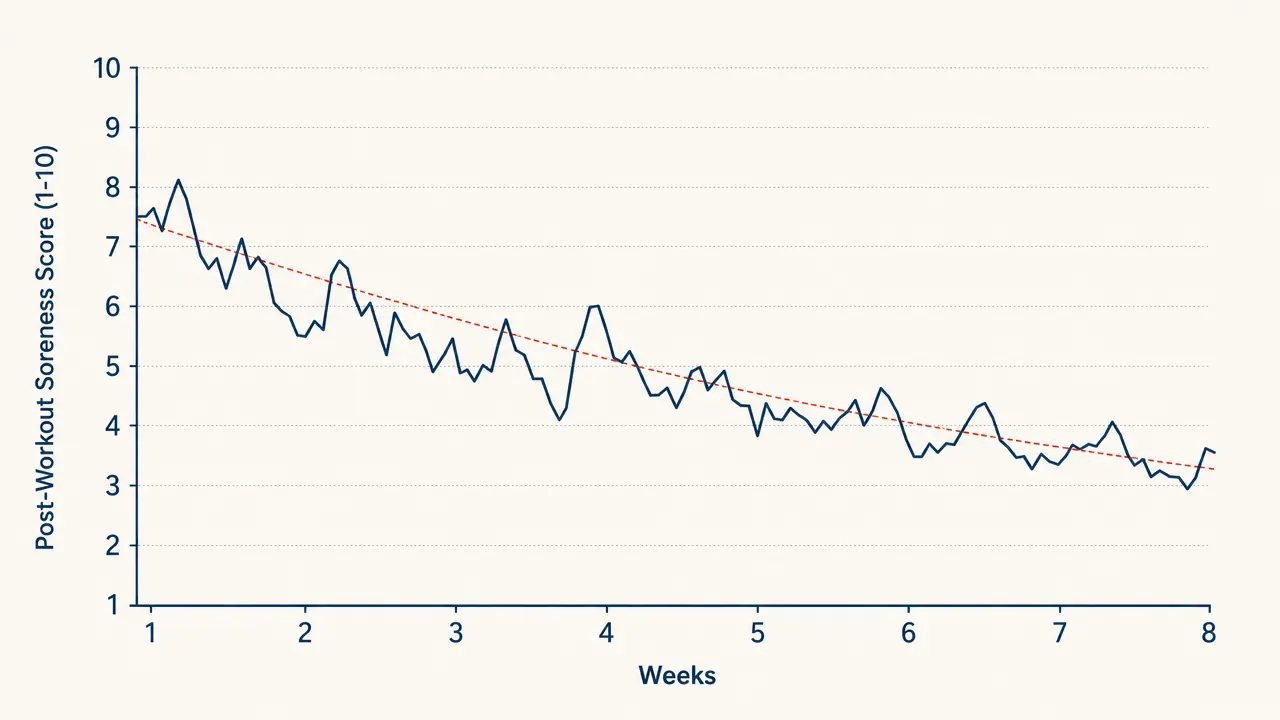
Week three: my lower back soreness after deadlift days dropped. I went from averaging a 7-8 the morning after pulling to a 4-5. That is not a cure, but it is genuinely significant when you are dealing with this every week. By week four I was doing heavy deadlift sessions and not needing the heating pad the same night.
I tracked soreness scores for eight weeks. By week eight my daily average was a 3.5, down from a baseline of 7.2. I know eight weeks of self-reported data is not a clinical trial. But for my own body, the pattern was consistent enough that I would notice if I skipped three days in a row.
By week four I was doing heavy deadlift sessions and not waking up needing a heating pad. That is not nothing. That is the difference between training being sustainable or not.
The Attachments: Which Ones Actually Matter
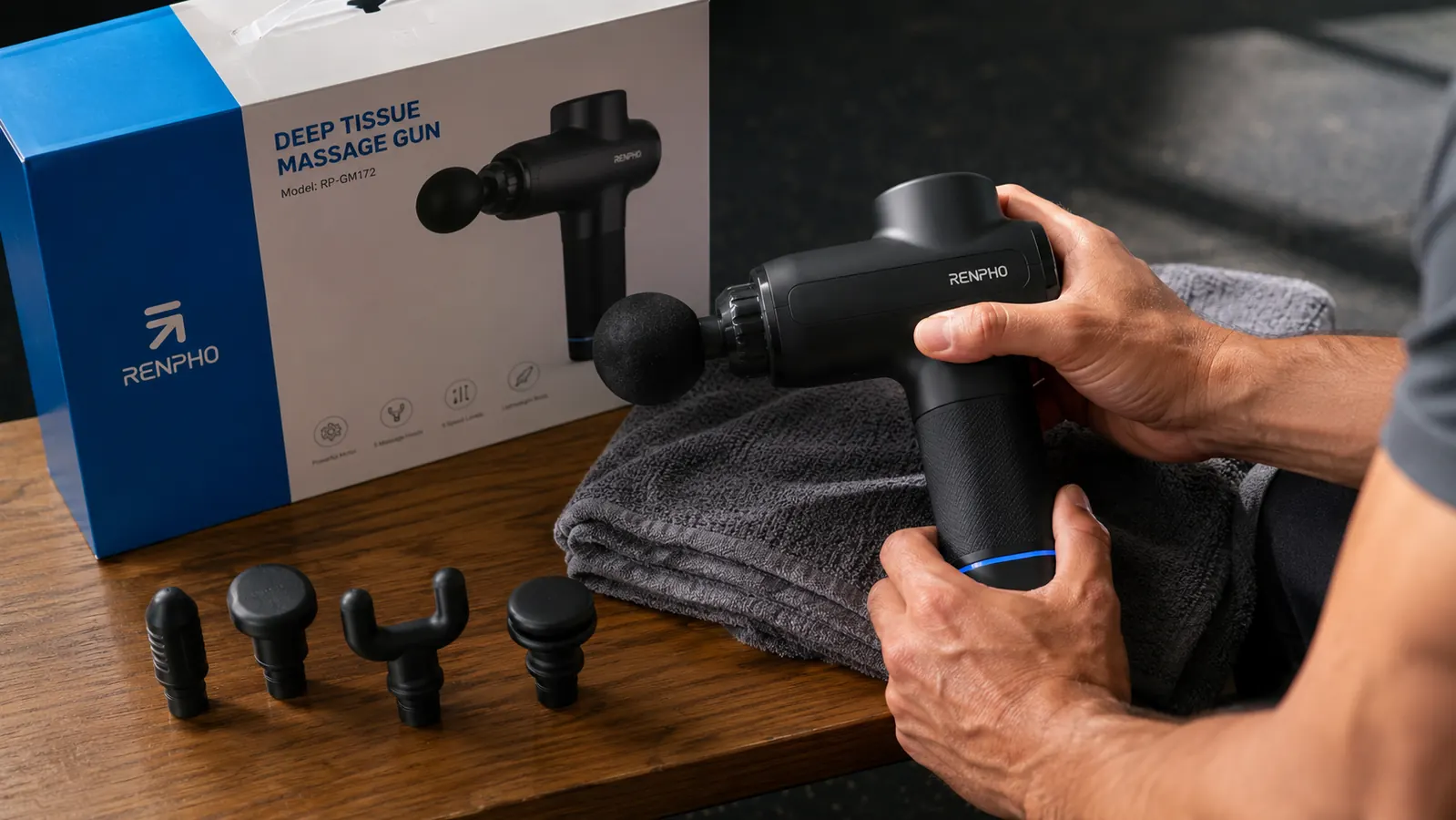
The RENPHO comes with five heads. In four months I have used three of them with any regularity. The ball head is the one you will use 70% of the time. It is versatile, it does not dig in uncomfortably on bony areas, and it works well on the erectors, glutes, and outer quads. The fork head is the other one I use constantly, specifically on the traps and along the thoracic spine where the ball head feels too blunt. Running the fork head down the erectors with a two-inch gap on each side of the spine is the closest thing to a real massage I have found at this price.
The flat head is useful for large flat muscle groups like the chest or inner quad. The bullet head is for very specific trigger point work, and I will be honest: I have used it twice. It is aggressive. If you are not already comfortable with massage gun pressure, start with the ball and work your way there over a few weeks. The thumb head I have not found a good use case for. Your experience may differ.
One thing worth knowing: do not use this on the neck, directly on the spine, or near bony prominences. The RENPHO's top speed is aggressive enough to cause bruising if you are pressing into a poorly targeted spot. Stick to the muscle belly, float the head rather than pressing hard, and keep moving. Stalling it in one spot for more than thirty seconds in the early weeks is how people get sore in a bad way.
Noise Level and Build Quality After Four Months
The RENPHO is marketed as quiet. The lowest two speed settings genuinely are. I can use it while my partner is asleep in the same room without waking her, which is a real practical consideration if you are doing nighttime recovery work. Speeds 3 through 5 are louder, more like a cordless drill running into resistance. I rarely use anything above speed 3 on the lower back because the lower speeds with more passes cover the same ground without the noise.
Build quality has held up without any complaint over four months of daily use. The battery still charges fully and holds a charge for what feels like multiple sessions. I charge it about twice a week. The grip is comfortable, though after about fifteen minutes my forearm starts to feel the weight if I am working a stubborn spot. It weighs around 2.2 lbs, which sounds light on paper but is noticeable during an extended session on your own back where your arm is in an awkward position.
The only durability note: one of the attachment heads started to feel slightly looser in its socket around month three. It still works and has not fallen off, but the click-lock mechanism is not as satisfying as it was new. This is a minor thing but worth knowing if you are comparing it to a more expensive gun where build tolerances are tighter.
What the RENPHO Does Not Do Well
The amplitude on the RENPHO is 10mm. That is on the lower end for a percussion massager at this price. Most Theragun models in the premium range run 12-16mm. What that means practically: for very deep tissue work on thick muscles like the glutes or upper hamstrings of someone over 180 lbs, the RENPHO can feel like it is vibrating on the surface rather than actually penetrating the tissue. I hit this limitation most obviously on heavy squat days when my glutes are genuinely wrecked. The gun helps, but it does not have the amplitude to fully reach that depth.
If you are under 160 lbs or you are primarily targeting upper back, neck area muscles, calves, and forearms, you will probably never feel this limitation. If you are a 200+ lb person doing heavy compound lifts and you are expecting this gun to mimic a sports massage, it will fall short on the thickest muscle groups. That is not a criticism, it is just physics and price. For everything it costs, it delivers solid value. Just go in with accurate expectations.
The carry case is sold separately on some listings and bundled on others. Check your specific listing before ordering. I got mine without a case, and storing it in a drawer with the heads loose is not ideal. A neoprene sleeve from a phone-case drawer works fine as a workaround.
What I Liked
- Quiet on the two lowest speeds, usable at 10pm without waking a sleeping partner
- Fork attachment is genuinely excellent for trap and thoracic work
- Four months of daily use with zero mechanical failures or battery degradation
- Measurably reduced post-deadlift soreness starting around week three
- Light enough to use comfortably for 10-12 minute sessions
- Charging twice per week covers daily use with battery left over
Where It Falls Short
- 10mm amplitude is limiting for deep glute and hamstring work on larger, heavier lifters
- Speed 4 and 5 are noticeably loud, on par with a handheld vacuum
- One attachment head developed minor looseness in its socket by month three
- Carry case not always included depending on which listing you buy
- Forearm fatigue kicks in around the 15-minute mark if you are reaching around to your own back
Compared to What I Tried Before
Before the RENPHO I had tried a budget handheld massager from a pharmacy chain. The vibration frequency on those is more like a high-frequency buzz than actual percussion. There is a meaningful mechanical difference between vibration and percussion, and the RENPHO is genuinely in a different category. The depth and the stall force make it feel like actual tissue work rather than skin-level buzzing. I also tried a foam roller for six months. The foam roller is useful and I still use it, but it is passive, requires getting on the floor, and cannot reach the traps without a partner. The massage gun wins for the post-workout nighttime recovery protocol because you can do it sitting on the edge of the bed.
I have not used a Theragun or a Hyperice in any serious head-to-head comparison. If you need the deepest possible amplitude for elite training loads and you can spend three times what the RENPHO costs, there are probably better tools at that price point. For most people reading this, that comparison is not relevant to the decision they are actually making. See my full comparison breakdown in the RENPHO vs Bob and Brad article if you are trying to decide between two options at a similar price.
Who This Is For
This gun is genuinely excellent for people who lift four to five days per week and have consistent tightness in the upper back, traps, and lower back erectors. It is excellent for people who work on their feet all day and want something they can run on their calves and plantar area in the evening. It is excellent for anyone who has wanted a massage gun for a while but was not sure if they would actually use it regularly enough to justify premium pricing. At its price point, if you use it five nights a week for a year, you are paying less than one massage appointment per month for daily relief. That math is hard to argue with.
The 30,000-plus reviews and 4.6 stars on Amazon reflect a product that works well for a very wide range of people with standard recovery needs. It is not a specialty tool for elite athletes with demanding tissue requirements. It is a very good everyday tool for people with everyday bodies that have everyday mileage. That includes me, and it probably includes you. For more detail on the ten specific ways this gun changes soreness patterns, check out 10 Reasons the RENPHO Massage Gun Beats Post-Workout Soreness.
Who Should Skip It
If you are a 220-lb powerlifter doing 500-lb deadlifts and you need serious glute and hip flexor work, the 10mm amplitude will frustrate you. Look at the Bob and Brad D6 Pro or spend up to a Theragun Prime. If you have an active injury, a fracture, bone spurs, or severe nerve issues like a flare-up of L4-L5 symptoms, a percussion massager can make things worse. I have a mild herniated disc and I use the RENPHO carefully on the surrounding musculature, not on the spine itself. If your back situation is acute or you are post-surgery, clear it with your PT before ordering any massage gun. And if you are someone who buys exercise equipment and lets it collect dust, buy a budget foam roller first and prove you will use it for a month. The RENPHO will still be available.
Four months in, I would order it again. The nighttime 15-minute protocol on the traps and lower back genuinely changed how I recover.
The RENPHO is rated 4.6 stars across 30,000+ Amazon reviews. Check today's price and make sure you are buying the version with all five attachment heads.
Amazon Check Today's Price on Amazon →